More interesting than the story of the actual filming of the notorious 1963 version of
Cleopatra (to us, anyway), is the twisted path that led to its final casting. Of course, the film itself is more memorable in retrospect for its gaudy spectacle, the scandalous off-screen romance of its stars, and the elevation (and downfall) of
Elizabeth Taylor from mere movie star to the $1 million poster girl for wretched excess, than for any merits or flaws of its own.

To put Taylor's power and prestige into perspective, compare her then-shocking, unheard-of $1 million fee for
Cleopatra to the salaries of, arguably, the three other most famous actresses of the day,
Doris Day,
Audrey Hepburn and
Marilyn Monroe. For
Breakfast at Tiffany's (1961), Hepburn made (a still-impressive) $750,000, while Monroe, incredibly, was still bound to a 20th Century Fox "slave contract" which netted her a total of $100,000 for the
Something's Got to Give (1962) debacle. Details of Day's earning power eluded us, but reportedly, when
My Fair Lady (1964) was made with Hepburn as Eliza Doolittle, Hepburn became only the second actress to receive $1 million for a film (after Liz); which means that Doris was making less than that, despite being ranked as the Number One Box Office Star
in the world. Of course, Hollywood being the incestuous place that it is, all of these ladies had close and competitive connections: Monroe and Taylor had long been locked in a feud as the two most famous women in the world; with all of the
Cleopatra hoopla in the press, Monroe gleefully predicted that her planned nude scene in
Something's Got to Give would "push Liz off the magazine covers" once and for all.


MM probably had her bones to pick with the demure Miss Hepburn, too; although Audrey didn't engage in the kind of celebrity catfights upon which tabloids are built (at least, not until she took the Julie Andrews-originated role in
Lady -- and even then, the
Lady-like Hepburn and Andrews didn't raise their well-modulated voices, and let the gossip columnists concoct their own spins on the "rivalry"), it's a fairly open secret that the iconic role of Holly Golightly in
Breakfast at Tiffany's was written by Truman Capote expressly with Marilyn Monroe in mind. Certainly, on paper, Capote's sexy-but-shy, kooky-yet-sensitive pre-bohemian is far more Norma Jeane than Audrey. Reportedly, Capote fumed, "Paramount double-crossed me in every way and cast Audrey." Still, it appears that MM had no one but herself and her dependence on outside influence to blame for this loss: plans were set to go forward with La Monroe as Holly, but she turned the offer down on the advice of Actors' Studio guru Lee Strasberg, who warned MM against playing a thinly-disguised prostitute.


Of course, Doris Day would "inherit" MM's unfinished
Something's Got to Give, revised, recast, and reshot to suit Day's altogether different talents. Whether or not the original would have been better than the eventual
Move Over Darling (1963) is pure conjecture; but while Day's film received only mediocre reviews (and is far less-revered today than most of her other movies from the same time frame), it continued her box office juggernaut, ranking as the sixth highest grossing film of the year.


And while Marilyn didn't live to offer any pointed observations about America's Oldest Virgin taking over a role from the reigning sex goddess of the world, Day had some unusually tart commentary on Elizabeth Taylor: "When I see Liz Taylor with those Harry Winston boulders hanging from her neck I get nauseated. Not figuratively, but nauseated! All I can think of are how many dog shelters those diamonds could buy."


But back to
Cleopatra. In 1959, when the film was in still in the pre-production stages, 20th Century Fox compiled a preliminary list of potential actresses for the lead. Not surprisingly, Marilyn Monroe made the list -- and though the casting was far-fetched, to say the least, it made sense from a business standpoint: Monroe was a Fox contract player (and, as noted before, a ridiculously low-paid one), and was coming off the heels of her biggest box office hit yet,
Some Like it Hot. Moreover, she owed Fox two more films under her contract, and as
Hot had not been a Fox film, studio execs were eager to get Monroe back on the lot and take advantage of her drawing power themselves. And, given the proper setting, costuming and makeup, perhaps Marilyn as Cleopatra wasn't so far-fetched; after all, she had recreated the role as played by Theda Bara, in a 1957
Life spread photographed by
Richard Avedon.

Straining credibility even more, Fox also considered Audrey Hepburn -- we're just thankful that Doris Day's status as the Number One Box Office attraction didn't automatically ensure her a place on the list! Other major stars of the time, such as Brigitte Bardot,
Kim Novak,
Sophia Loren and
Gina Lollobrigida,
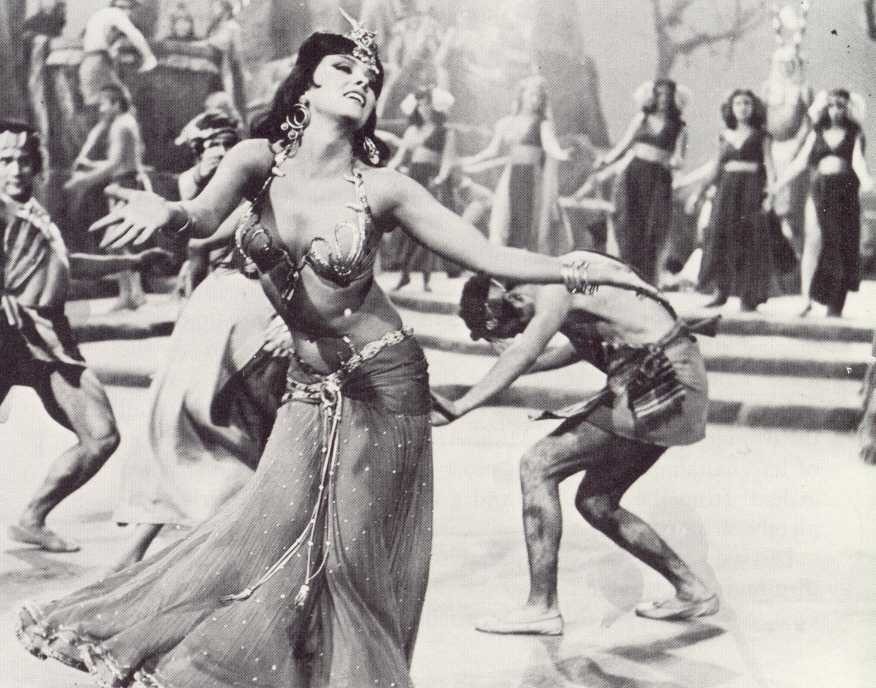
were included. While we can't quite picture the very French Mam'selle Bardot as the scheming Queen of the Nile, Novak, although an admittedly offbeat choice, had a certain enigmatic quality which may have somehow worked; while the splendiferous Sophia had the requisite exotic looks, and had already essayed the role in a racy, pre-Hollywood film called
Two Nights with Cleopatra (Due Notti con Cleopatra). Loren's arch rival, La Lollo, also could have carried off the Egyptian queen's legendary physical charms, and had recently made a splash in another historical epic,
Solomon and Sheba (1959).


In a surprising turn of events, the forerunner seemed to be the 41-year-old, redheaded veteran
Susan Hayward! In an October 8, 1959 letter,
Cleopatra's producer, Walter Wanger, wrote, "[Fox president Spyro] Skouras has taken a poll of everyone at the New York office, and they all want Susan Hayward to play Cleopatra. He told me he is going to announce Susan for the role immediately." Apparently, Hayward was the
second choice for the role; La Liz had already been courted by Wanger as early as 1958, but reputedly had no interest in the part. With Fox eager to jump on the "epic" bandwagon,
Cleopatra needed to go forward, and Hayward, seemingly, was their best bet -- like Monroe, she was a relatively inexpensive contract player, and Fox was nervous that the film's projected production costs would be such that corners should be cut wherever possible: namely, the star's salary. Hayward was also a hot property at the time, coming off of an Oscar win for
I Want to Live! (1958); plus, she had had experience in costume pictures.


Oddly, though, nearly as soon as Hayward was in, she was out; and Taylor was announced for the role. But it wouldn't be a smooth journey: between November 1958, when Liz was initially approached for the role, and September 25, 1961, when filming finally began in Rome on the already-beleagured production, the Widow Todd had, in short order, been made a public pariah after "stealing" Eddie Fisher from Debbie Reynolds; been seriously ill (forcing the initial filming at London's Pinewood Studios to shut down completely); had a tracheotomy; was reported as having died from pneumonia in the American news outlets; and then made a triumphant return to health, and a comeback into the public's good graces, culiminating in winning an Oscar for the MGM production of
Butterfield 8 (1960).
Shirley MacLaine, a fellow nominee that year for
The Apartment -- and a name bandied about as a possible replacement for Taylor in
Cleopatra in the wake of the London shutdown -- famously quipped, "I lost to a tracheotomy!" Perhaps, in the scene below from
Gambit (1967), MacLaine was Method Acting, thinking of La Liz in her
Cleopatra headdress finery while she was strangling that statue. Hell, for all we know, Shirl may have
been Cleopatra in a former life!


But when Taylor's fate, as well as the fate of
Cleopatra, was more tenuous, another actress was offered the role.
Joan Collins had come to Fox from England in 1955 as a double-edged competitor to Metro's Liz, and a warning shot to Fox's own recalcitrant Miss Monroe (Collins's first starring role was in a film MM had refused to do,
The Girl in the Red Velvet Swing). In 1960, she was given costume tests and, if memory serves us correctly (from reading her
Past Imperfect memoirs many moons ago), was even photographed amid the
Cleopatra sets sitting still and unused at Pinewood Studios in London. With Collins in the lead, the film would be drastically rebudgeted to just around $2 million,
total. Collins seemed a logical choice, if the film were to be reimagined on a smaller level: she was another Fox contract player, and not even a top-tier one, at that; she could have been hired for far less than even Monroe. She had long toiled in Taylor's shadow, as both were British beauties with similar features, voices and physiques; so taking over a Taylor-made role was no far stretch. Also, Collins had made an early splash in another Egyptian-themed Fox extravaganza,
Land of the Pharoahs (1955, with
Jack Hawkins).

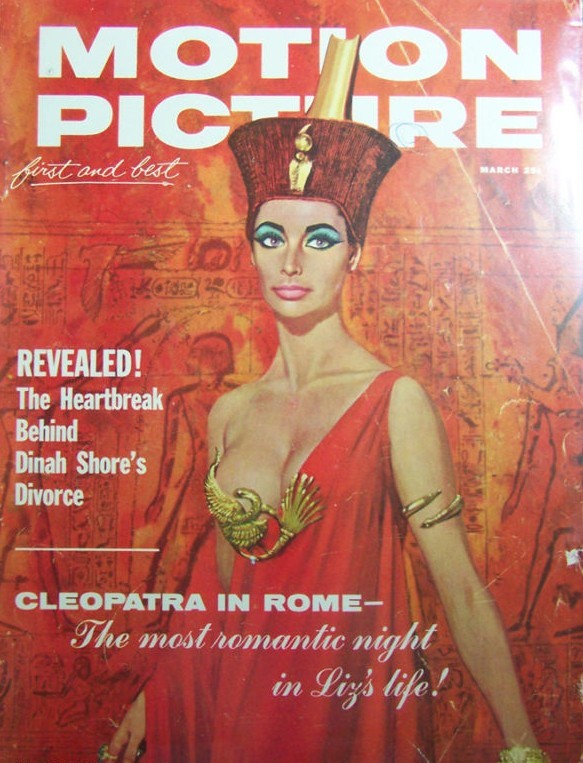
According to Collins herself, any hopes she may have had of playing Cleopatra were dashed when she refused to "be nice" to unnamed Fox producers and execs -- presumably, Walter Wanger and Spyro Skouras. At any rate, Collins's involvement was rendered moot when Elizabeth Taylor emerged from her illnesses with the full support of a forgiving public behind her -- and armed with an Oscar, to boot. In spite of the expense of having Taylor on the payroll, to say nothing of the problematic filming itself, Fox was no doubt betting that Taylor's superstar status alone could carry the film into the profit zone. As Marilyn Monroe had complained, Elizabeth Taylor as Cleopatra stared out from the covers of magazines worldwide, long before the film was ever close to being complete -- although, the illustrator of the first example below apparently still wanted Sophia Loren to have the role.


Filming would drag on for another year, with no shortage of travails and scandals: Taylor's continuing bad luck with physical maladies; the Egyptian government's initial refusal to allow her entry into the country because of her Jewish faith; the Burton affair, which led to the pair being condemned by the Vatican; to say nothing of the calamities the bloated production trickled down to the rest of Fox -- nearly all of their contract players were terminated (Monroe, Hayward and Collins among them) in the face of
Cleopatra's ballooning costs, and at one point, the Fox lot was a virtual ghost town: no other movie could afford to be in production. Hopefully, while Marilyn, Susan and Joanie were collecting their pink slips, they weren't aware of Liz living
la dolce vita in Rome, while having Chasen's famous chili flown in at a cost of $100 per day.
"The chili is so good. All gone now. Please send me ten quarts of your wonderful chili in dry ice to 448 Via Appia Pignatelli. - Love and kisses, Elizabeth Taylor."

Not surprisingly, the finished product could never live up to the hype; and after virtually three years of a non-stop barrage of publicity, critics and public alike were oversaturated with Liz, Dick, Cleo, Caesar, and the rest of them. Full disclosure: we have never been able to sit through
Cleopatra in its entirety. Oh, we try, periodically; but somewhere along the way, our minds and our butts grow far too numb to muddle through the other three hours of it. Frankly, we're more intrigued by the backstory, and tantalized by what might have been: imagine Julius Caesar getting the dressing down of his life by Susan Hayward's Brooklyn baritone. Or Joan Collins prepping for a second career of catfights on
Dynasty by rolling around the barge with hapless handmaidens. But honestly, looking ahead to the vanity project that is the 1974 version of
Mame, we can only breathe a sigh of relief that
Lucille Ball Productions never got their hands on this property.


 Kim Novak in 5 Against the House (1955, Columbia)